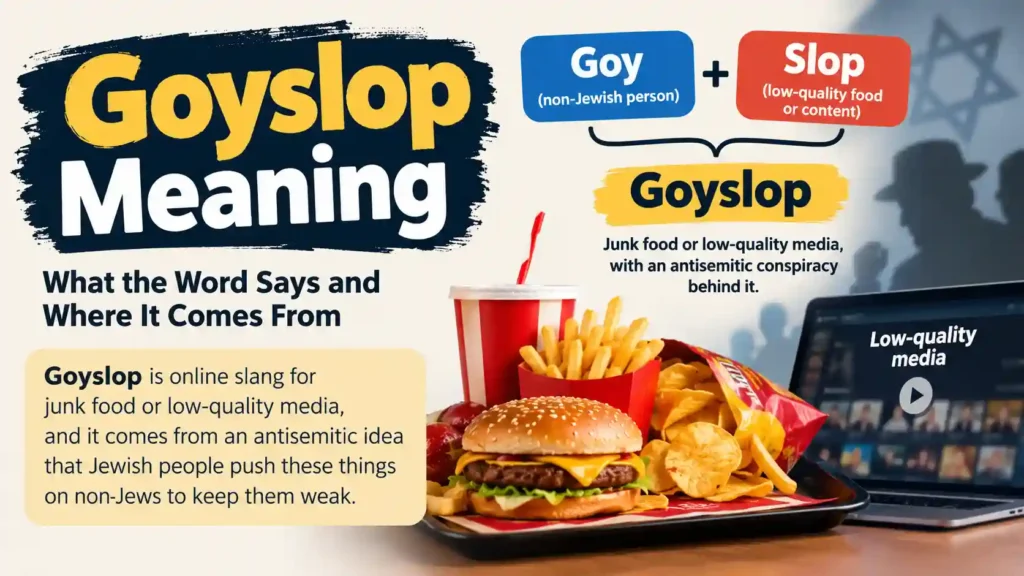
The goyslop meaning is simple. It is online slang for junk food or low-quality media, and it carries an antisemitic idea that Jewish people push these things on non-Jews to keep them weak. You may have seen the word in a meme, a comment, or a news story, and now you want a straight answer. That makes sense, because few people explain it well. Some users say it as a joke about burgers and chips. Others mean something much darker. In this article, you will learn what the word says, where it started, and why Jewish groups call it hateful. You will also see real examples, common mistakes, and better words to use. By the end, you will know exactly what you are looking at when you see it.
Quick Answer
Goyslop is internet slang for cheap, mass-made stuff, like fast food, junk snacks, or shallow movies. However, the word adds a false claim. The claim says Jewish elites plan this stuff on purpose so non-Jews stay unhealthy and easy to control. Because of that claim, Jewish groups and many news outlets call the term antisemitic. So even a joking use carries a conspiracy idea inside it.
Goyslop Meaning in Simple Words
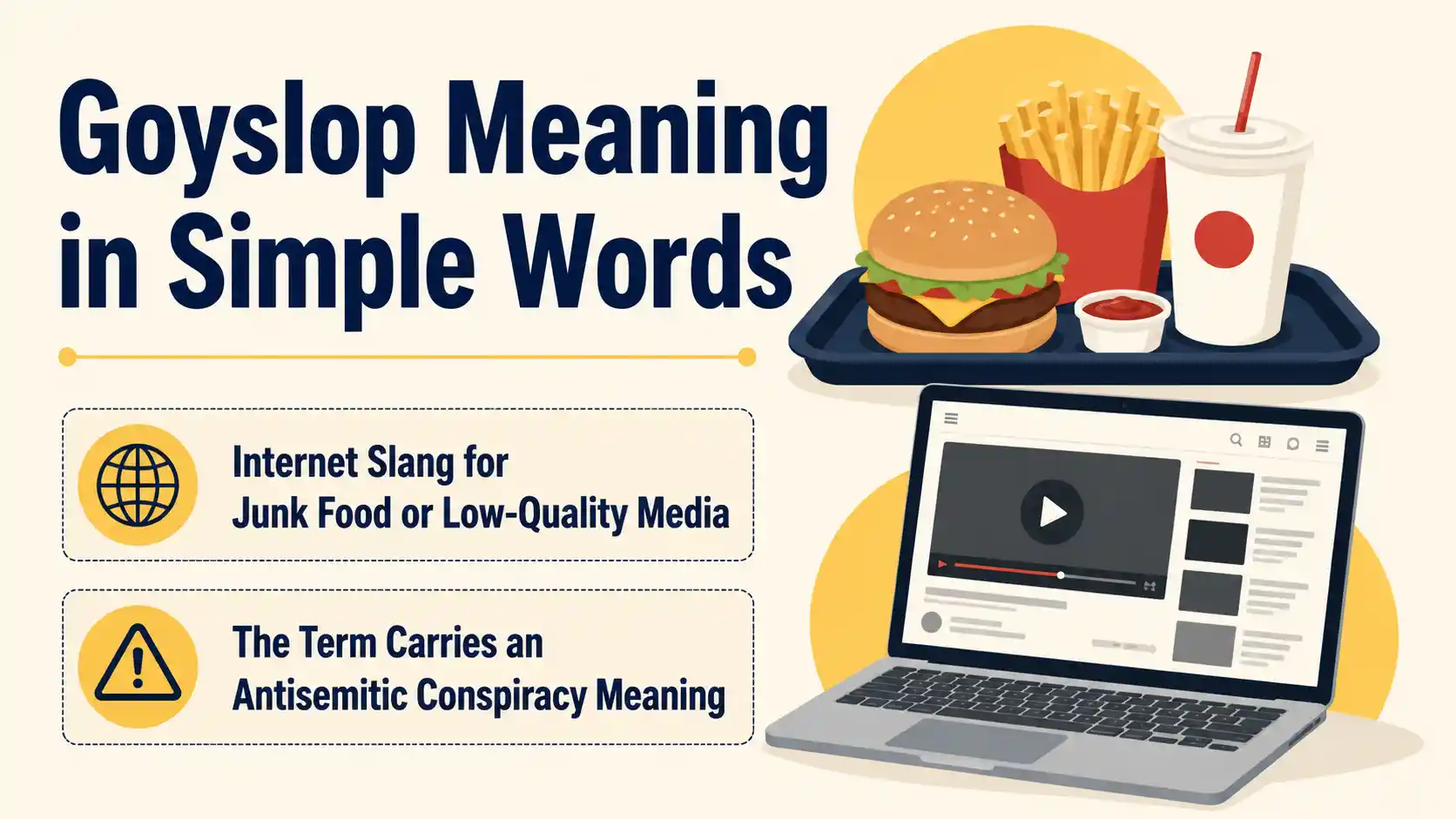
Picture a school lunch tray full of greasy, soft food. Now imagine someone says a secret group made it that way on purpose. Then they say that group is Jewish. That is the idea packed into the word goyslop.
In daily use, people attach the word to many things. For example, it might describe burgers, soda, chips, or frozen meals. It can also describe loud action movies, endless streaming shows, or empty viral videos. Writers say it grew out of an older antisemitic myth that Jews promote poor goods to weaken non-Jewish people.
The blame story is the key. Without it, the word would just mean “junk.” With it, the word points a finger at one group of people. As a result, many news outlets and Jewish groups treat it as an antisemitic term instead of harmless slang.
Breaking Down the Word Part by Part
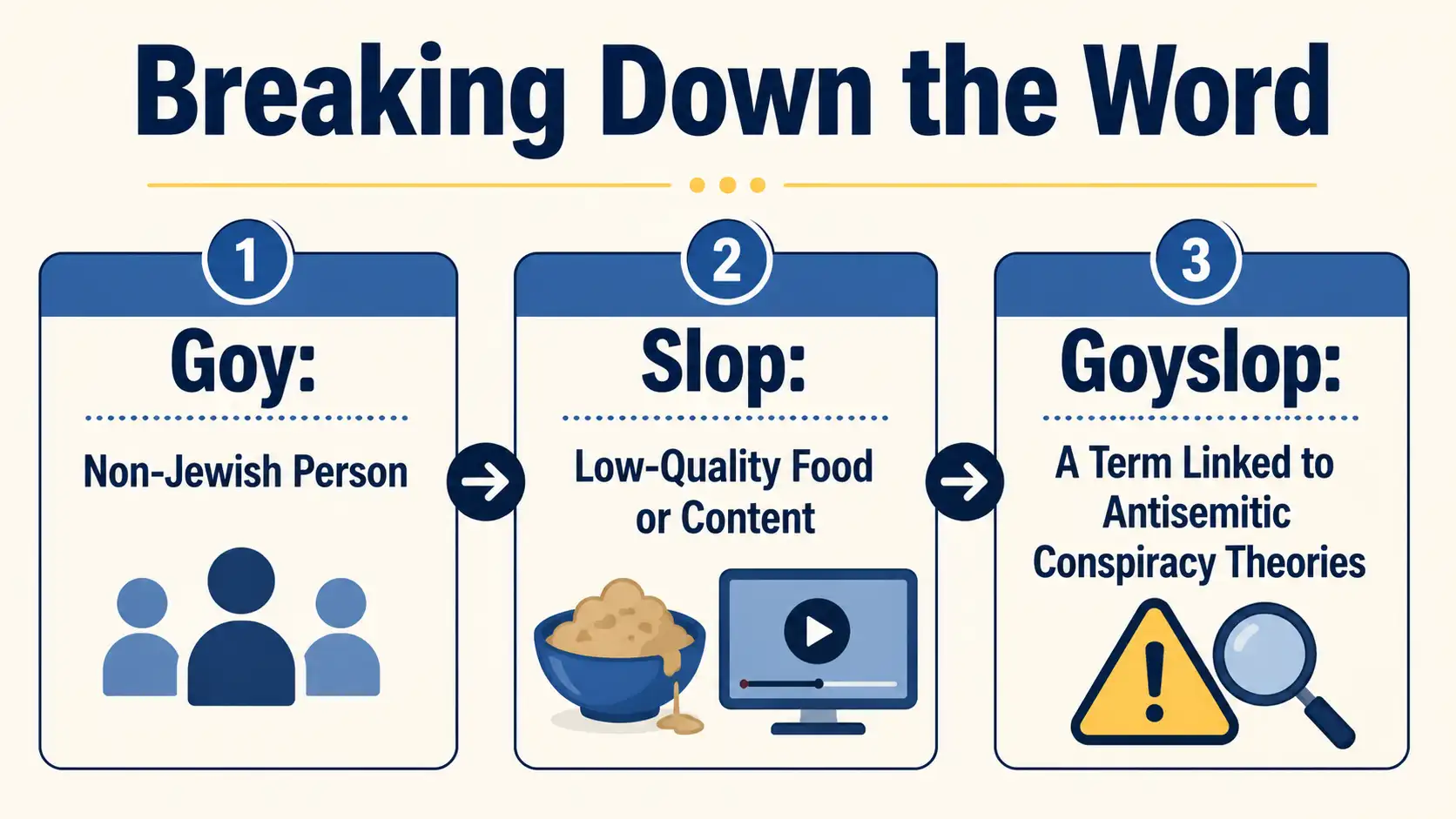
The word has two parts, and each one has its own story. Looking at them side by side makes the meaning easier to see.
| Word Part | Basic Meaning | Role in “Goyslop” |
| Goy | A Hebrew and Yiddish word for a non-Jewish person | Points to the people who supposedly get “fed” the junk |
| Slop | Low-quality, messy, or unwanted food or content | Points to the junk food or junk media |
| Goyslop | A mix of both words | Junk that Jewish elites supposedly push on non-Jews |
The word “goy” has a long and tangled history. In Hebrew, it simply means “nation.” In Yiddish, it grew into a word for a non-Jewish person, and it can sound rude or neutral depending on the speaker. Some scholars say the word is only descriptive in its plain sense. In daily speech, though, it can carry either tone.
“Slop” has a long English history too. People have used it for watery, messy, or low-grade food for a very long time. Today, it also describes low-effort online content, such as spammy AI images. So when someone adds “goy” to “slop,” they borrow that familiar meaning and attach blame to a group.
Where Did Goyslop Come From?
The exact starting point is a little fuzzy, but reliable reports agree on the big picture. One Jewish source says people first used the word around 2016. Wikipedia’s summary points to early use on anonymous message boards, and other coverage traces it to far-right online spaces. Meanwhile, some language experts urge caution on small details. For instance, writers on a well-known linguistics blog point out that people have called certain foods “slop” for a long time, so the “slop” half is not new.
Most sources agree on the path the word took. First, it grew in small, extreme corners of the internet. Then it moved into memes and short videos. Along the way, it reached many users who had no idea where it came from. That pattern is common with internet slang. A word starts in a hateful place, and then it travels so far that regular people repeat it without knowing its past.
Another trend helps explain the word. For years, white supremacist groups have used “goy” in a twisted, ironic way. According to the Southern Poverty Law Center, they use it to describe themselves and to signal belief in conspiracy theories about Jews. Goyslop grew out of that same world.
Why Goyslop Is Considered Antisemitic
Antisemitism means hatred of, or prejudice against, Jewish people. Goyslop fits that definition because of the story it tells.
The story goes like this. Jewish people secretly control food companies, movie studios, and the media. They then use that control to hand out cheap, harmful products. Finally, the goal, the story says, is to make everyone else sick, tired, and obedient.
None of that is true. Still, it echoes an old pattern. For hundreds of years, hateful stories have blamed Jewish people for the problems of the society around them. Those stories often claim that Jews secretly run things behind the scenes. Goyslop is a modern, meme-sized version of that old idea.
Sources call the term antisemitic because it links complaints about unhealthy food to a conspiracy theory about Jewish control. That link turns a food complaint into a hate message.
Here is another way to see it. You can say “this food is unhealthy” and be right, since many processed foods have lots of sugar, salt, and fat. Or you can say “companies care more about profit than health” and start a real debate. Those are fair points. The antisemitic part begins when someone adds “and Jews did it on purpose.” That extra claim has no facts behind it.
How People Use Goyslop Online
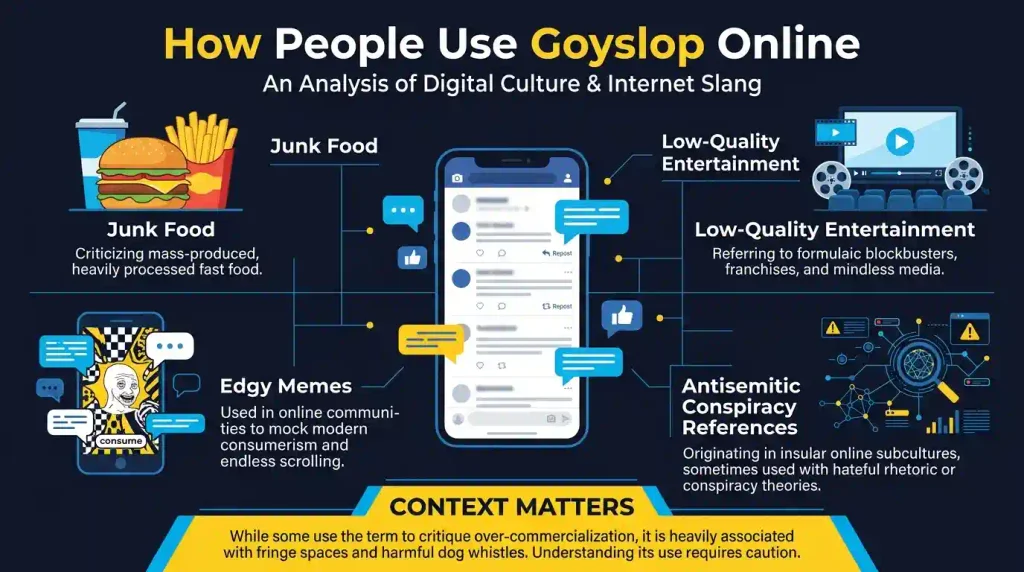
The word shows up in a few different ways. Knowing them helps you read the room.
| Way People Use It | Where You See It | What Is Going On |
| Serious hate talk | Extremist forums and accounts | The speaker fully means the conspiracy idea |
| Political attack | Campaign speeches and posts | Speakers criticize school food or media, often with the hateful meaning in the background |
| Edgy joke | Memes, short videos, group chats | Users treat it as “cool” slang, often without knowing the roots |
| Anti-corporate slang | Some online posts | Users mean “corporate junk,” though critics say the roots still matter |
| Mocking the term | Jewish commentators and others | Speakers throw the word back at people who spread hate |
The word first referred mostly to junk food. Since then, it has spread to entertainment, including films and television. So you might see it beside a burger photo in one post and a superhero movie in the next.
Not everyone who uses it today belongs to a hate group, though. Some young people say it as a funny catchphrase. However, that does not change the origin of the word. It does mean you should check the context before you guess what someone intends.
Goyslop in the News
The word moved from message boards into public debate in recent years. A few moments stand out.
In late 2024, The Forward, a Jewish news outlet, wrote about the term after it popped up in talk about changing American food rules. That piece gave many readers their first clear explanation.
Then, in 2026, James Fishback, a Florida candidate for governor, used the word at a campaign event while he criticized school lunches. News outlets reported it widely, and Jewish advocacy groups condemned it for its roots in antisemitic internet culture. Later reports say he used the term again at another campus event.
Around the same time, the New York Times covered how the word spreads among teenagers. One high school student told the paper that most kids at his school know it. He said he understands its roots but uses it for fun. The Anti-Defamation League pushed back on that coverage. It said teen use does not change the fact that the term began as an antisemitic slur tied to white supremacist conspiracy theories.
As a result, two views now sit side by side in public talk. One view says the word has lost much of its original meaning because so many people use it casually. The other view says the origin still matters, and that casual use lets hateful ideas slip into everyday speech. Experts quoted in coverage warn that joking use can let extreme ideas into the mainstream.
Why So Many People Use It Without Knowing
You might wonder how a word with such dark roots became so popular. Several simple reasons explain it.
First, the internet moves fast. A word can jump from one meme to a million screens in days. By then, the story of where it started is gone.
Second, the word sounds funny. “Goyslop” is short and punchy, and it is easy to say. Words like that spread because they are catchy, not because people agree with the message.
Third, “slop” is already trendy. People talk about “AI slop” and “slop bowls” all the time now. Therefore, a new word ending in “slop” does not feel strange.
Fourth, many people do not know the word “goy.” Some who first see “goyslop” guess that “goy” is a typo or a brand name. In fact, one report noted that some users, even outside the far right, do not understand the word’s origins.
None of this makes the word harmless. It simply explains how it got so far.
Common Mistakes People Make
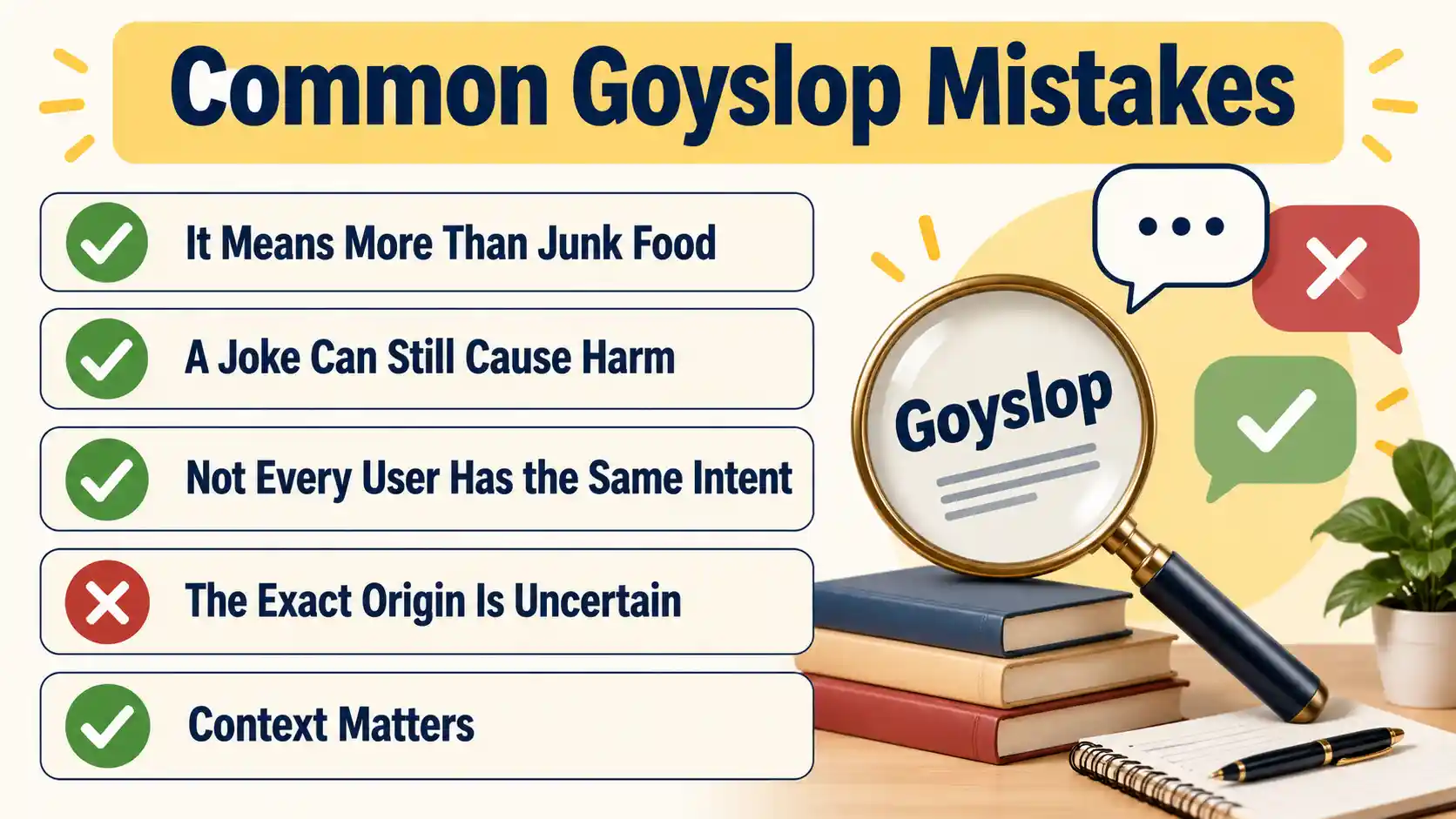
Many readers get a few things wrong when they first learn about this word. Here are the most common mistakes.
Believing it only means junk food. Many people think goyslop is just a fancy way to say “junk food.” In truth, that is only half the story. The blame story is what sets it apart from ordinary words like “junk” or “trash.”
Assuming “goy” is always an insult. In some settings, “goy” is just a plain word for a non-Jewish person. The trouble with goyslop comes from the full phrase and the conspiracy behind it, not from the single word on its own.
Guessing that only hate groups use it. Hate groups helped spread it. Yet regular users, including some on the left and many young people, repeat it too. If you assume every user is an extremist, you will be as wrong as if you assume no one is.
Treating a joke as a safe zone. A joke can still carry a message. When humor wraps a hateful idea, the idea feels less serious, and that is exactly how it spreads.
Mixing it up with real food criticism. Nothing is wrong with criticizing fast food, school lunches, or big companies. You can do that without this word. Real health concerns deserve plain, fair language.
Believing experts agree on every detail. Researchers and writers still debate small details, like the exact first use. Even so, the antisemitic idea behind the word is clear.
Real-Life Examples
Seeing the word in context helps. I invented these examples to show how it might appear. They do not quote real people.
Imagine a comment under a fast-food ad that says, “Eat your goyslop and stay quiet.” The writer claims the food keeps people weak, and the “goy” part points at a group. That is the conspiracy meaning.
Now picture a friend who sends you a meme of a greasy burger with the word on it, just to be funny. They may not know the history. Still, the word carries it, so a kind reply might be, “Hey, that word has an antisemitic backstory. Maybe skip it.”
Here is a third case. A politician says school meals are “goyslop.” Even if the politician claims to mean only that the food is unhealthy, many listeners will hear the hateful meaning, because the word comes with it. That is why such moments draw strong reactions.
A final example flips the usual use. According to one report, commentator Ben Shapiro accused Tucker Carlson of spreading “goyslop” over a claim about Israel. In that case, Shapiro turned the word back on Carlson to mock a claim, not to spread the conspiracy. This shows how messy the word’s use has become.
What to Say Instead of Goyslop
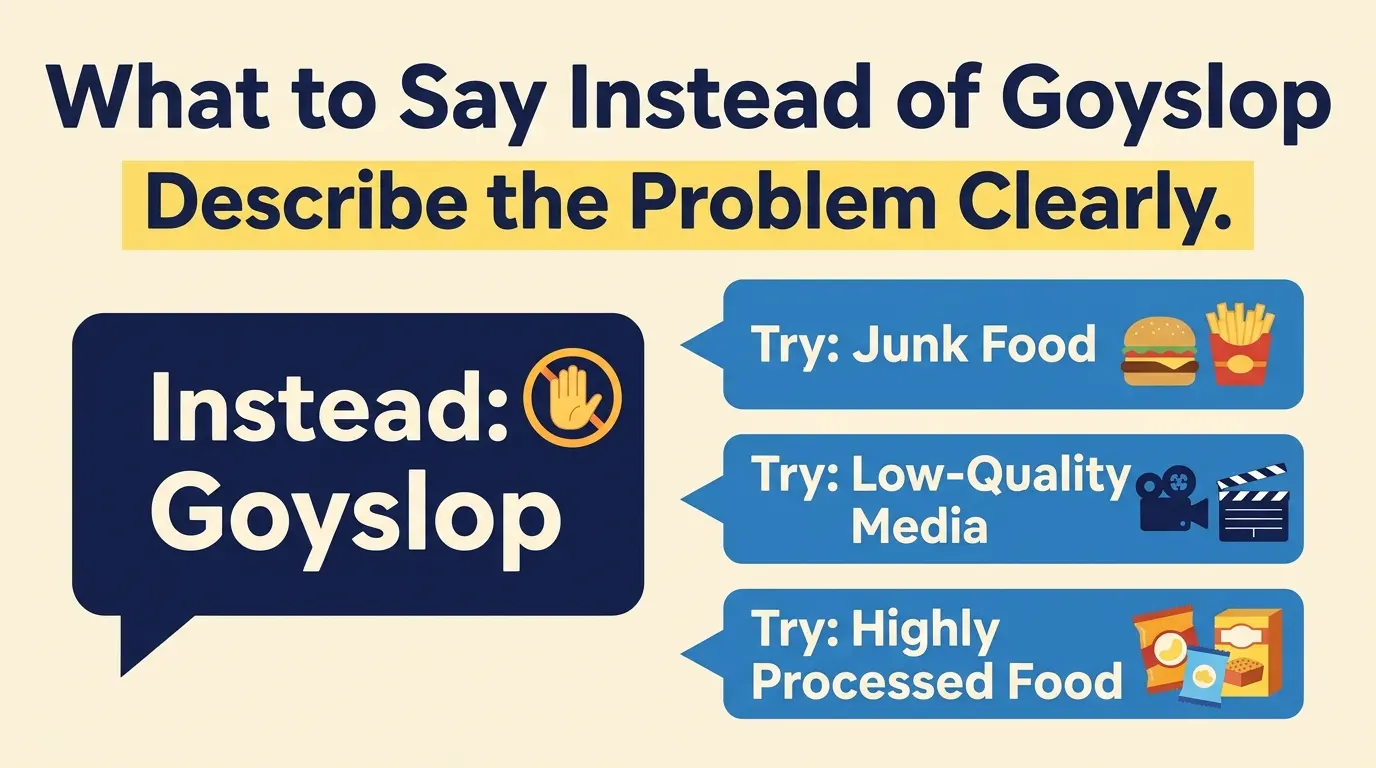
If you want to complain about food or media, you have plenty of clear, fair choices. Using them keeps your point sharp and avoids a hateful message.
| Instead of This | Try This | Why It Works |
| “This school lunch is goyslop.” | “This school lunch is unhealthy and low quality.” | Names the real problem |
| “That movie is goyslop.” | “That movie feels shallow and built to sell tickets.” | Gives a clear opinion |
| “Fast food is goyslop.” | “Fast food is highly processed and high in sugar and salt.” | Sticks to facts |
| “They feed us goyslop to control us.” | “Big companies often put profit ahead of health.” | Makes a fair, debatable point |
| “Stop eating goyslop.” | “Try cooking more meals at home.” | Gives useful advice |
Notice that each fix is also clearer. When you name what is wrong, readers know exactly what you mean. A loaded word can hide your real point.
How to Respond When You See It
You may run into this word in a group chat, a comment section, or a family gathering. No single response is right, but a few simple steps usually work well.
First, stay calm. A short, friendly note often works better than an angry one. For example, you might say, “Just so you know, that word comes from an antisemitic idea.” Many people who use it simply do not know.
Next, keep the focus on the word, not the person. People listen more when they do not feel attacked. Also, offer a replacement like “junk food” or “low quality,” so they have an easy way to change.
If the person keeps using it after hearing the history, or if the post is clearly hateful, you can report it. Most social media sites ban hate speech and harassment.
Finally, take care of yourself. If you are Jewish and the word upsets you, that makes sense. You do not have to explain it to everyone. Instead, share your feelings with friends or groups you trust, or step away when you need to.
FAQs
What does goyslop mean?
It is internet slang for cheap, low-quality food or media. However, the word also carries a false claim that Jewish elites push such things on non-Jews to harm them. Because of that claim, Jewish groups and many experts call it antisemitic.
Is goyslop a slur?
The Anti-Defamation League and other Jewish groups call it an antisemitic term. It does not insult one person directly. Instead, it spreads a hateful conspiracy about Jews, so most experts treat it as hate speech in meme form.
Where did the word goyslop start?
It grew in far-right online spaces, and one Jewish source says people first used it around 2016. Still, experts do not agree on the exact first use. What is clear is that it grew in extreme communities before it spread into memes and short videos.
Can I use goyslop as a joke?
It is best not to. Even as a joke, the word carries an antisemitic idea, and many people will read it that way. Also, experts warn that casual use can make hateful ideas feel normal. Plain words like “junk food” make your point without the baggage.
Is the word “goy” always offensive?
No. In Hebrew, it first meant “nation,” and in some settings it is just a plain word for a non-Jewish person. In Yiddish and modern slang, however, it can sound rude. Context and tone matter a great deal.
Why do people use “slop” for so many things?
“Slop” is a handy word for anything cheap, messy, or low-effort. People use it for sloppy food and, these days, for spammy online content like low-effort AI images. That is why a word ending in “slop” feels natural, even when it hides a deeper meaning.
Conclusion
The goyslop meaning comes down to this: it is a catchy slang word for junk food and shallow media, but it rests on an antisemitic conspiracy theory. That theory says Jewish elites plan cheap products to keep non-Jews weak. The idea is false, and it has deep roots in old hate stories.
The word spread through memes and videos, so many people repeat it without knowing its past. Some defend it as harmless fun. However, Jewish groups and many experts disagree, and they warn that joking use can help hate spread.
Your best move is simple. If you care about healthy food or better movies, say so in clear words. Try “junk food,” “highly processed,” or “low quality.” Those words are honest, easy to understand, and kind. And if you spot goyslop online, you now know what the word really says.

Hi, I’m Anam, the writer behind ContentWireMedia. I’m passionate about explaining word meanings, phrases, and everyday expressions in simple, clear English. My goal is to help readers understand language better and find reliable answers to their questions with ease.