
Piety meaning in simple words: piety is deep respect and devotion to God or to a faith. It shows up in how a person prays, acts, and treats others. The word can also mean loyal respect for family, especially parents.
Maybe you saw “piety” in a book, a news story, or a school test. Maybe someone called a person “pious,” and you wondered if that was a compliment. Many people search for the piety meaning because the word sounds old and a little serious. It is also easy to mix up with “pity.”
In this guide, you will learn what piety means, where the word came from, and how to say it. You will see tables, real examples, common mistakes, and answers to six common questions. By the end, you can use the word with confidence.
Quick Answer: Piety Meaning in Plain English
Piety is the quality of being devoted to your religion and showing it in daily life. A person with piety prays, follows the rules of their faith, and tries to live in a good and respectful way. Piety is about the heart and the habits, not just words.
Here is the short version in a table.
| Question | Short Answer |
|---|---|
| What part of speech is piety? | A noun |
| What does it mean? | Deep devotion to God or a faith |
| What is the adjective? | Pious |
| What is the opposite? | Impiety |
| Can it mean something besides religion? | Yes, loyal respect for parents or duty |
| How do you say it? | PIE-uh-tee |
If you only need a quick answer, that is it. The rest of this article adds the details that make the word easy to remember and use.
Piety Meaning and Definition
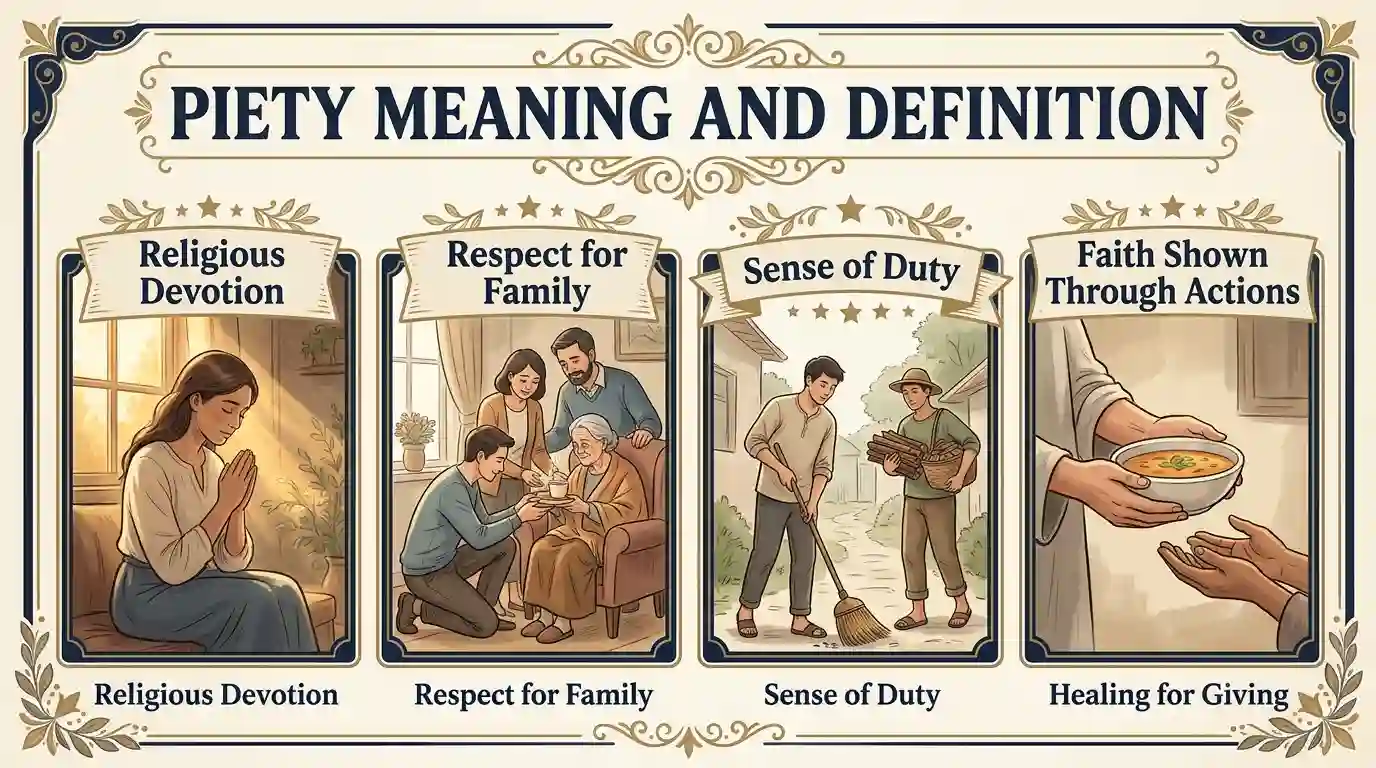
Most dictionaries explain piety in two ways. The first meaning is about religion. It describes a strong, sincere love for God and a life shaped by that love. The second meaning is about duty. It describes loyal respect for family, country, or a person’s responsibilities.
Think of piety as faith that you can see. Many people believe in God. A person with piety also lives in a way that matches that belief. They might pray each day, go to services, help people with low-income, or tell the truth even when it is hard.
Piety is not the same as being loud about religion. A quiet person can have deep piety. Someone who gives food to a neighbor and never talks about it may be more pious than someone who talks about faith all day. Most religious teachers say the same thing: real devotion shows in your actions and your attitude.
The word also carries a feeling of humility. A pious person usually sees themselves as a servant, not a boss. They respect something greater than themselves. That could be God, a holy book, or a set of values handed down by their family.
How to Say and Use the Word Piety
Say it like this: PIE-uh-tee. It has three parts. The first part sounds like the word “pie.” People sometimes say it too fast and drop the middle sound, but the middle “uh” is important.
Piety is a noun. That means it names a thing, like “honesty” or “courage.” You can use it as the subject of a sentence or as an object.
Here are a few simple examples:
- Her piety was clear to everyone in the village.
- The monk was known for his piety and kindness.
- Many people admired the piety of the old grandmother.
The adjective form is “pious.” You can say “a pious man” or “a pious family.” The adverb form is “piously,” as in “He piously bowed his head.” The opposite noun is “impiety,” which means lack of respect for religion.
Piety is not a word you use for a single act. You would not say, “He showed piety by opening the door.” Piety describes a pattern, a steady way of living. It is a big word for a big idea, so it fits best when you talk about someone’s character over time.
Where the Word Piety Comes From

The word comes from the Latin word pietas. In ancient Rome, pietas meant a sense of duty and loyalty. A Roman with pietas respected the gods, cared for family, and served the community. It was one of the most admired qualities a person could have.
The word then passed into Old French, and from there it came into English in the Middle Ages. Over time, English speakers used it mostly for religious devotion. The older idea of family duty never fully went away, though. You can still hear it in the phrase “filial piety,” which we will cover soon.
Here is a fun fact. The word “pity” comes from the same Latin root. Long ago, “pity” and “piety” were closer in meaning. Both were linked to tenderness, mercy, and care. Over the years, they split into two separate words. “Pity” came to mean sorrow for someone’s trouble, while “piety” came to mean religious devotion.
Knowing this history helps the word stick. Piety started as a mix of love, loyalty, and duty. Even today, the best examples of piety include those same three things.
Piety in Different Religions
Almost every major faith has a word or idea close to piety. The details are different, but the heart is the same: a sincere life of devotion. The table below gives a simple overview.
| Religion | How Piety Often Shows Up |
|---|---|
| Christianity | Prayer, Bible reading, worship, kindness, and charity |
| Islam | Prayer, fasting, giving to people with low-income, and taqwa (God-consciousness) |
| Judaism | Prayer, study, keeping the commandments, and awe of God |
| Hinduism | Bhakti (devotion), worship, and living by dharma |
| Buddhism | Meditation, moral rules, compassion, and respect for teachers |
In Christianity, piety often means a close, loving bond with God. Many Christians link it to prayer, church life, and caring for others. In Islam, the word taqwa is often translated as piety or God-consciousness. It means staying aware of God in everything you do and avoiding what is wrong. In Judaism, piety is tied to observing the commandments and studying sacred texts, along with a deep respect for God.
In Hinduism, devotion is called bhakti. It can include prayer, songs, and offerings to a chosen god or goddess. Buddhism is a little different, because many Buddhist traditions do not focus on a creator god. Still, English speakers may describe a devoted Buddhist as pious because of their steady practice, kindness, and respect for the teachings.
Remember that “piety” is an English word. Each religion has its own terms, and those terms may carry shades of meaning that English cannot fully catch. When in doubt, use the term the faith itself uses.
Filial Piety: Respect for Parents

You may also see the phrase “filial piety.” This is the second major use of the word. Filial piety means respect, love, and care for your parents and elders.
The idea is strongest in East Asian cultures, especially those shaped by Confucian teaching. In Chinese, the idea is called xiao. It teaches that children should honor their parents, care for them in old age, and remember their ancestors. A famous old text, the Classic of Filial Piety, is built around this idea.
Filial piety can look like many everyday things. A young adult might call their mother each week. A family might share a home so grandparents are never alone. A child might work hard in school partly to make their parents proud. Many families also hold ceremonies to honor ancestors.
Other cultures have similar ideas, even if they use different words. Many families around the world teach that you should respect your elders and care for them when they need help. Some people today also discuss the limits of filial piety, such as when duty to parents clashes with a person’s own needs. That is a fair conversation, and it shows the word is still alive and debated.
Piety vs. Similar Words
Piety has a few cousins that look alike but are not twins. Here is how they compare.
| Word | Meaning | How It Differs From Piety |
|---|---|---|
| Piety | Devotion shown in daily life | The full package: belief plus action |
| Faith | Trust or belief in God or ideas | Faith is belief; piety is living it out |
| Devotion | Strong love and loyalty | Broader; can be for a person or cause |
| Holiness | Being sacred or morally pure | Often describes God or a holy person |
| Reverence | Deep respect and awe | A feeling; piety includes the habits too |
| Religiosity | How religious a person is | A neutral measure, not always a virtue |
| Righteousness | Being morally right | Focused on right behavior |
The easiest way to tell piety and faith apart is to ask a simple question. Does the word describe what you believe, or what you do? Faith is mostly about belief. Piety is about living that belief every day.
Piety and holiness are also different. Holiness often describes something set apart as sacred, like a holy place or a holy book. A person might be called holy, but “piety” is the word for their devoted way of life.
Positive and Negative Sides of the Word
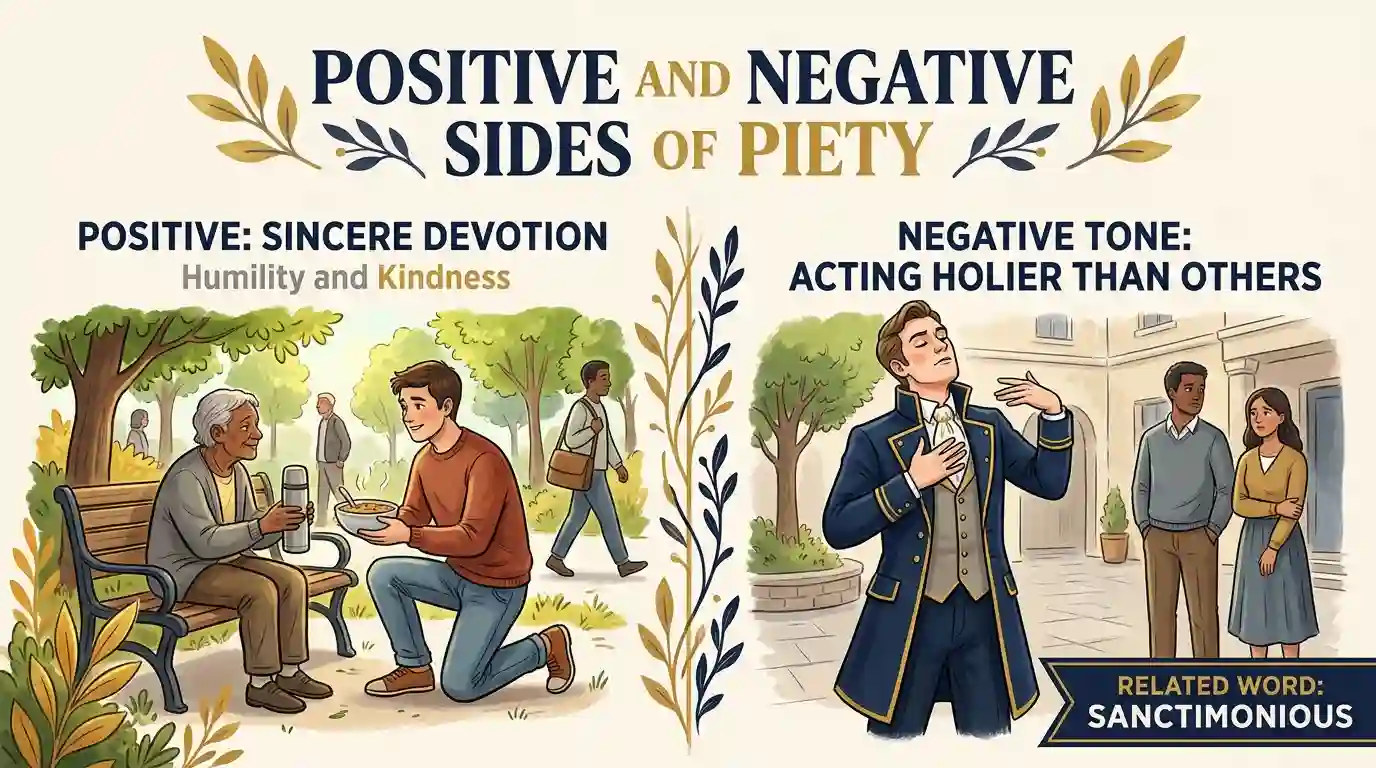
Piety is usually a compliment. Calling someone pious often means they are sincere, humble, and good-hearted. In many communities, piety is one of the highest praises you can give.
But the adjective “pious” can sometimes have a sharper edge. If someone says, “Stop being so pious,” they may mean the person is acting holier than everyone else. In that case, the word sounds close to “preachy” or “self-righteous.” The tone and the situation make all the difference.
You may also hear the word “sanctimonious.” It describes someone who pretends to be very moral or religious to look better than others. That is not true piety. Real piety is quiet and sincere, while a fake show of it is closer to hypocrisy.
A helpful rule is to think about the speaker. If a writer is describing a character’s honest devotion, “pious” is probably kind. If a character is rolling their eyes while saying it, the word is likely sarcastic. Reading the tone is the key.
Common Mistakes to Avoid
Even native English speakers trip over this word. Here are the mistakes you will see most often.
Mixing up piety and pity. These words share a root but mean different things. Piety is devotion. Pity is sadness for someone else’s trouble. “I feel pity for him” is correct. “I feel piety for him” is not.
Using piety for one act. Piety describes a long-term way of life, not a single moment. Instead of saying “That prayer showed piety,” you could say “That prayer showed devotion.”
Writing “piousity.” This is not a standard word. The correct noun forms are “piety” and “piousness.” Most writers prefer “piety.”
Assuming it always means a specific religion. Piety is not tied to Christianity or any one faith. You can use it for people of any religion.
Treating it as only a positive word. As we saw, “pious” can be sarcastic. Check the tone before you use it in a way that might sound rude.
Forgetting the middle sound when speaking. Say PIE-uh-tee, not “PIE-tee.” The three-part rhythm helps people understand you.
Real-Life Examples of Piety
Examples make a word easier to remember. Here are some pictures of piety from daily life.
A grandmother gets up early each morning to pray before she starts her day. She is gentle with the children and shares her food with neighbors. People in her town say, “Her piety is an example to us all.”
A young man fasts during a holy month and gives part of his money to charity. He does not brag about it. His friends notice his steady habits, and they respect him for it.
A woman volunteers at a shelter every weekend because her faith teaches her to serve the needy. She sees her work as part of her devotion.
A farmer stops each evening to give thanks for the harvest, whether it was good or bad. His piety is not about getting rewards. It is about gratitude.
Here are a few book and history-style sentences that show the word in action:
- “The king was famous for his piety, building churches across the land.”
- “Pilgrims showed great piety by walking for many days to reach the holy site.”
- “She hid her piety behind a humble smile.”
Notice that in every example, the person’s belief shows up in what they do. That is the heart of piety.
Piety Today: How the Word Is Used Now
You will not hear “piety” in everyday chat as often as words like “faith” or “religion.” It tends to appear in books, history lessons, news about religion, and thoughtful conversations. Even so, the idea is very much alive.
Today, people talk about piety in many settings. Scholars study how piety shapes cultures and families. Writers use it to describe characters in novels. Journalists may use it when reporting on religious festivals, pilgrimages, or community traditions.
The meaning has also grown a little. Some people talk about “quiet piety,” meaning faith lived without a show. Others discuss “public piety,” meaning visible acts like parades or group prayers. Some even use the word in a non-religious way, such as “a pious devotion to tradition,” meaning strong loyalty to a belief or custom.
There is also a modern debate about whether piety should be private or public. Some people feel faith belongs in the heart and home. Others feel it should shape public life too. The word piety sits in the middle of that conversation, which is one reason it still matters.
Tips for Using the Word Piety Well

A few simple habits will help you use the word naturally.
Use piety when you want to describe a steady pattern of devotion, not a one-time act. Pair it with clear details so readers can picture it. Instead of saying only “She had great piety,” you might say “Her piety showed in her daily prayers and her kindness.”
Pick the right form. Use “piety” as the noun, “pious” as the adjective, and “piously” as the adverb. Keep “impiety” for the opposite idea.
Watch your tone. If you want to praise someone, “devout” or “faithful” can sometimes feel warmer than “pious.” If you want to hint at fakeness, “sanctimonious” is a clearer choice.
Respect the faith you are describing. If you are writing about a particular religion, try to learn its own words and ideas. A short explanation of terms like taqwa or bhakti shows care and builds trust with your readers.
Lastly, if you are a student, try writing three sentences of your own with the word. Practice is the fastest way to make a new word part of your own vocabulary.
FAQs
What is the simple meaning of piety?
Piety means deep devotion to God or a religion, shown through how a person lives. It can also mean loyal respect for parents and family duties.
What is an example of piety?
A person who prays every day, helps people in need, and stays humble is showing piety. The key is that their beliefs show in their actions.
What is the difference between piety and pity?
Piety is religious devotion. Pity is sadness for someone else’s trouble. They come from the same Latin root but now mean very different things.
What does filial piety mean?
Filial piety means respect, love, and care for your parents and elders. It is a strong idea in Confucian teaching and many East Asian cultures.
Is piety a good thing?
Usually, yes. Most people see piety as a sign of sincerity and good character. The word “pious” can sometimes sound sarcastic, though, so tone matters.
What is the opposite of piety?
The opposite is impiety, which means a lack of respect for God or religion. Words like irreverence and ungodliness are also close opposites.
Conclusion
The piety meaning comes down to this: piety is devotion that you live out, not just talk about. In its main sense, it is deep respect and love for God or a faith. In a second sense, it is loyal care for parents and duty, as in filial piety. The word began with the Latin pietas, a mix of love, loyalty, and duty, and that old spirit still shapes it today.
Remember the key points. Piety is a noun, pious is the adjective, and impiety is the opposite. Do not confuse it with pity. Look at the tone, because “pious” can be a warm praise or a sharp jab.
Here is some practical advice. The next time you read or hear the word, ask yourself, “What actions show this person’s devotion?” That small question will help you understand the word and use it well. Keep this guide handy, and your vocabulary will grow stronger.

Hi, I’m Anam, the writer behind ContentWireMedia. I’m passionate about explaining word meanings, phrases, and everyday expressions in simple, clear English. My goal is to help readers understand language better and find reliable answers to their questions with ease.