
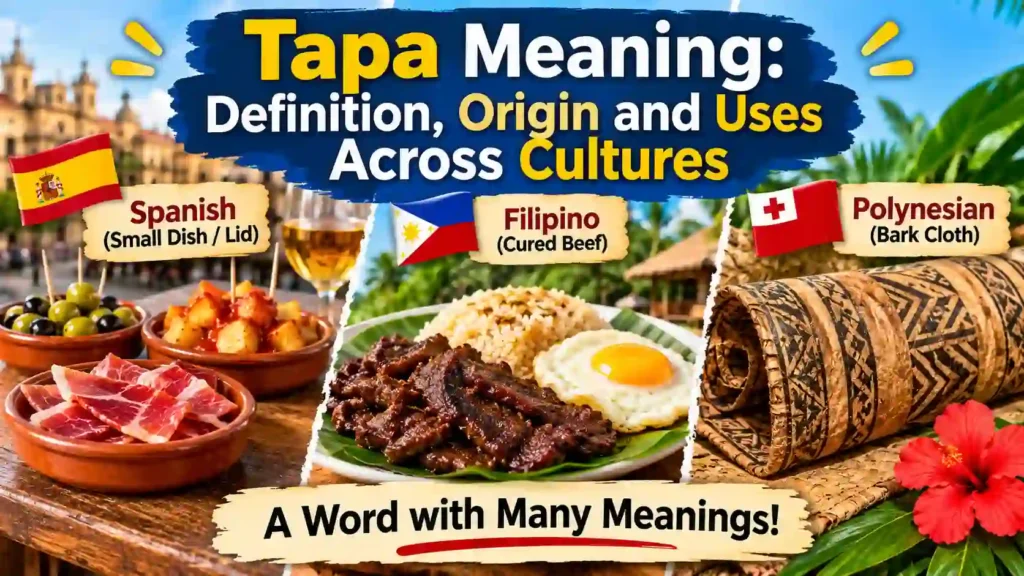
Have you ever wondered what the word “tapa” means? Its meaning changes across languages and cultures. In Spain, it refers to a small food dish or a lid, while in the Philippines, it means cured, thinly sliced meat.
Across the Pacific islands, tapa refers to traditional bark cloth used in ceremonies, clothing and art. The word also appears in folk poetry and place names.
In this guide, you’ll explore the different meanings of tapa, its origin, pronunciation and uses across cultures. By the end, you’ll understand the word in different contexts.
What Does Tapa Mean? (Quick Answer)
Tapa has several meanings, depending on the language and culture. In Spanish, it means a “lid” or “cover,” and it also describes a small portion of food that comes with a drink. In Filipino cuisine, however, it refers to thinly sliced cured meat, usually beef. In Polynesian cultures, meanwhile, it means a cloth that people make from the beaten inner bark of trees.
Why Does Tapa Have Multiple Meanings?
The same spelling developed separately in different languages. For example, the Spanish and Filipino meanings may connect through Spain’s history in the Philippines, although experts still debate the origin of the Filipino word. In contrast, the Polynesian word comes from Pacific island languages and has no link to either. As a result, a search for “tapa meaning” can return very different results.
Tapa Meanings at a Glance
| Language / Region | Meaning | Example |
|---|---|---|
| Spanish | Lid, cover; a small dish of food | “She ordered three tapas with her drink.” |
| Filipino | Cured, dried meat (usually beef) | “Tapsilog pairs tapa with rice and egg.” |
| Polynesian | Bark cloth | “The bride received a large piece of tapa cloth.” |
| Pashto / Urdu (as tappa) | A short folk poetry form | “She sang a tappa at the gathering.” |
How Do You Pronounce Tapa?
Spanish speakers say TAH-pah, stressing the first syllable. In Filipino, people often say tah-PAH, stressing the second. English speakers usually say TAH-pah when they talk about tapa cloth. In all three cases, the vowels sound short and open, like the “a” in “father.”
Tapa Meaning in Spanish
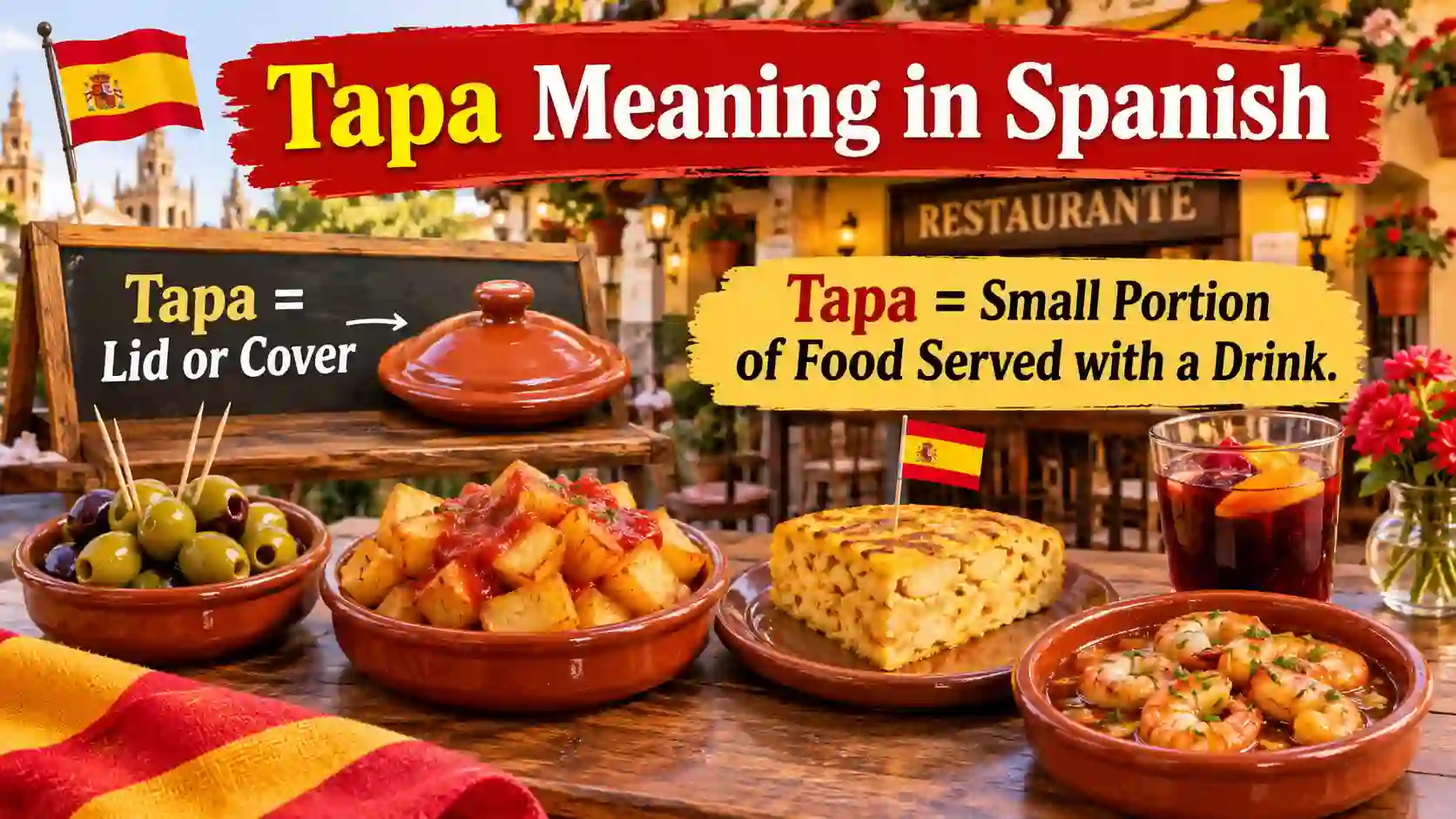
In Spanish, tapa comes from the verb tapar, which means “to cover.” As a result, the word has several everyday meanings.
Lid or Cover
The original meaning is a lid, cover or cap. For example, Spanish speakers say la tapa de la olla for a pot lid and la tapa del libro for a book cover. This meaning forms the root of the food sense.
Tapa as a Small Portion of Food
In bars and taverns, a tapa is a small portion of food that comes with a drink, such as olives, a slice of tortilla or a few prawns. Moreover, the plural “tapas” describes the whole style of eating, where friends share many small dishes.
Origin of the Tradition
Nobody knows for sure how the tradition began. According to one legend, bartenders covered glasses of wine or sherry with bread or ham to keep out flies. Another legend says King Alfonso X of Castile ordered taverns to serve food with wine after he recovered from an illness. Because historians have not proven either story, treat both as legends.
Tapa vs Tapas
Tapa is singular, while tapas is plural. In some cities, such as Granada, a free tapa often comes with each drink. Elsewhere, however, customers order tapas separately. Larger sharing plates carry the name raciones, and in the Basque Country, people call small bites on bread pintxos.
Popular Examples
Common tapas include patatas bravas, tortilla española, jamón ibérico, croquetas and gambas al ajillo. Besides food, tapa also means the cover of a book or magazine and, in some regions, a cut of beef.
Tapa Meaning in Filipino Cuisine
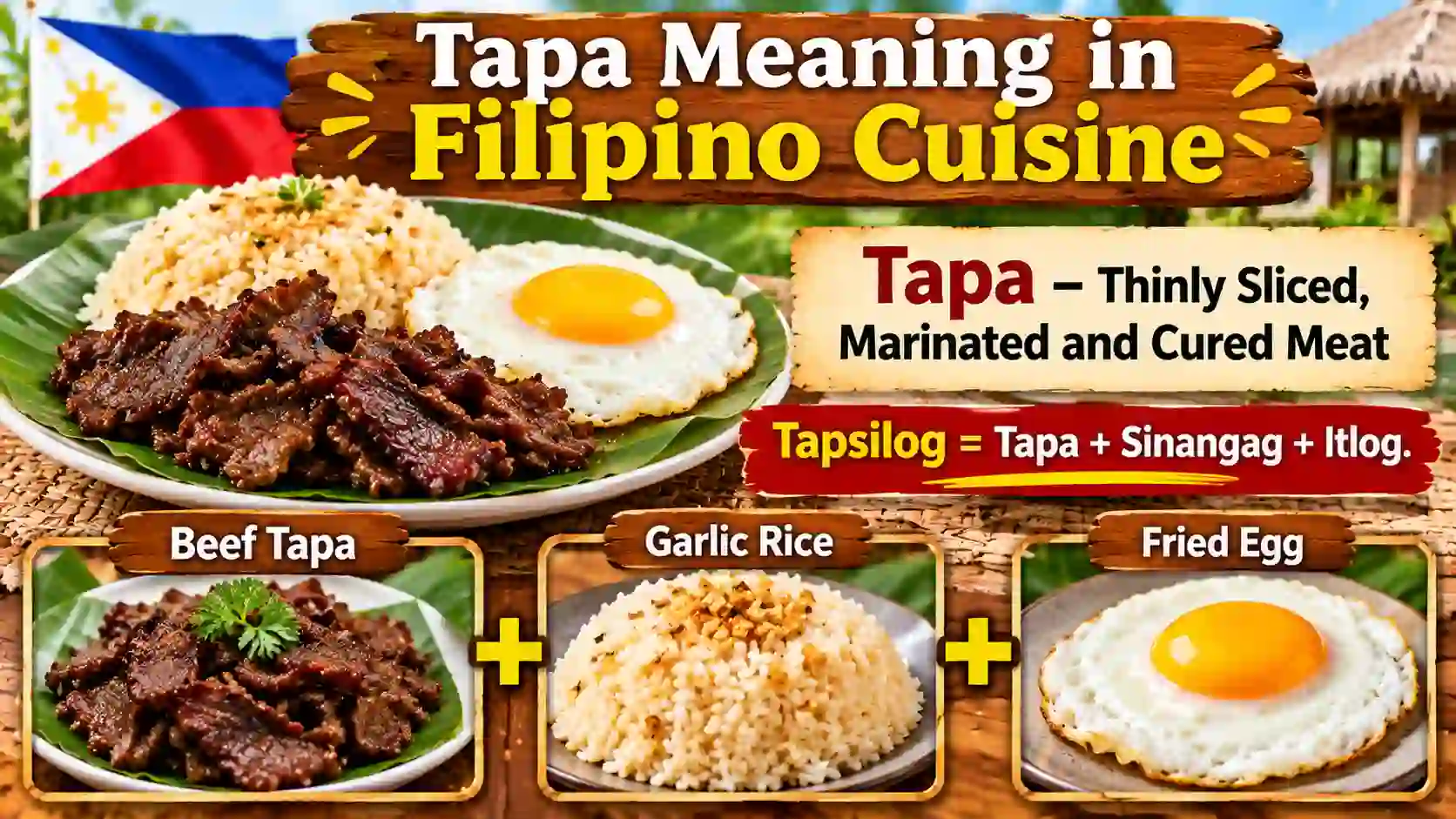
In the Philippines, tapa means cured, thinly sliced meat, most often beef, and it ranks among the country’s most popular breakfast foods.
What Is Filipino Tapa?
Cooks marinate and cure the meat, then fry or grill it until the edges brown. The flavor is savory, salty and slightly sweet, with a strong garlic note. Most people serve it with rice and a dipping sauce of spiced vinegar.
How Cooks Make It
First, cooks cut beef into thin strips. Next, they marinate the strips in soy sauce, garlic, black pepper, sugar and vinegar or calamansi juice. The meat then cures for one to several days, and traditionally people sun-dry it. Finally, they pan-fry it. Today, however, most home cooks cure tapa in the refrigerator.
Tapsilog Explained
The most famous way to eat tapa is tapsilog, a name that combines three parts:
- Tap: from tapa
- Si: from sinangag (garlic fried rice)
- Log: from itlog (egg)
It belongs to a family of “silog” meals, such as tocilog, longsilog and bangsilog. In addition, it appears on breakfast tables and at small eateries (carinderias) everywhere.
Variations
Beef is the most common choice. However, cooks also make tapa from pork (tapang baboy), venison (tapang usa), carabao and chicken. Tapang Taal from Batangas is especially well known.
Where Does the Word Come From?
Experts still debate where the word comes from. Some link it to the Spanish word because Spain ruled the Philippines for more than 300 years. Others, however, point out that the meanings differ greatly and that Filipinos already cured meat long before. Therefore, it is safest to treat this as an open question.
Tapa Meaning in Polynesian Culture (Tapa Cloth)
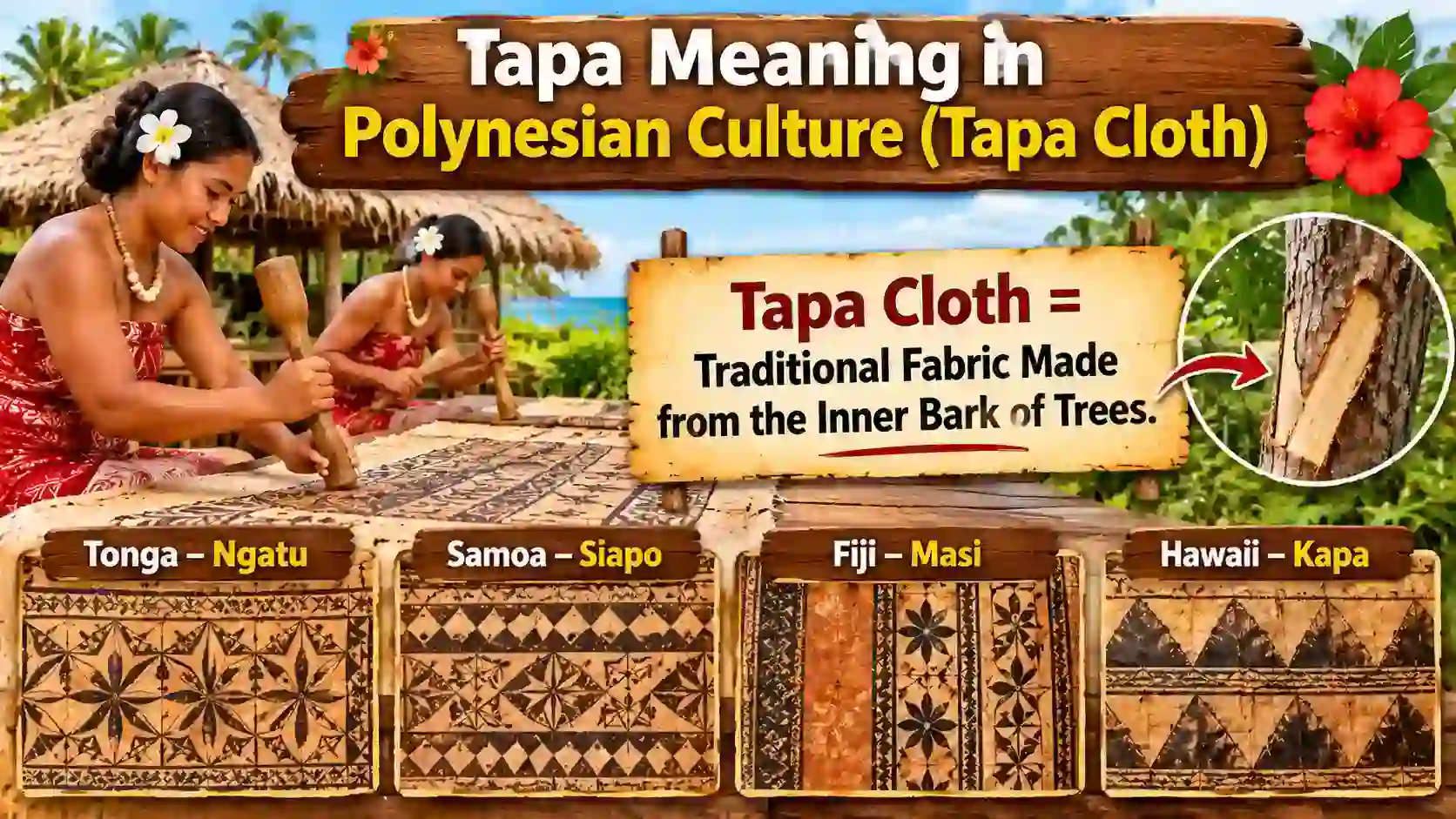
In the Pacific islands, tapa means a traditional cloth that artisans make from tree bark. It counts among the oldest textile arts in Polynesia. Because the word comes from Pacific languages, it has no connection to the Spanish or Filipino meanings.
What Is Tapa Cloth?
Tapa cloth, also called bark cloth, comes from the inner bark of trees, most commonly the paper mulberry. Unlike woven fabric, makers soak and beat the bark until the fibers spread and bond into a thin sheet.
How Makers Create It
Women traditionally do this work, and the process has five steps:
- Harvest: strip the bark from young trees.
- Prepare: separate, clean and soak the inner bark.
- Beat: pound it with wooden beaters until it widens and thins.
- Join: overlap and bond several sheets into larger pieces.
- Decorate: dye, paint or stamp it with natural pigments.
Names by Island
| Island / Region | Name |
|---|---|
| Tonga | Ngatu |
| Samoa | Siapo |
| Fiji | Masi |
| Hawaii | Kapa |
Cultural Importance and Today
Tapa cloth symbolizes status, family and tradition. For instance, families use it in weddings, funerals, gift exchanges and clothing, and its patterns often tell family or community stories. Today, many Pacific communities still make it, museums display it and modern artists use it in their work. In addition, buying from authentic Pacific makers helps support the tradition.
Other Meanings of Tapa and How to Use the Word
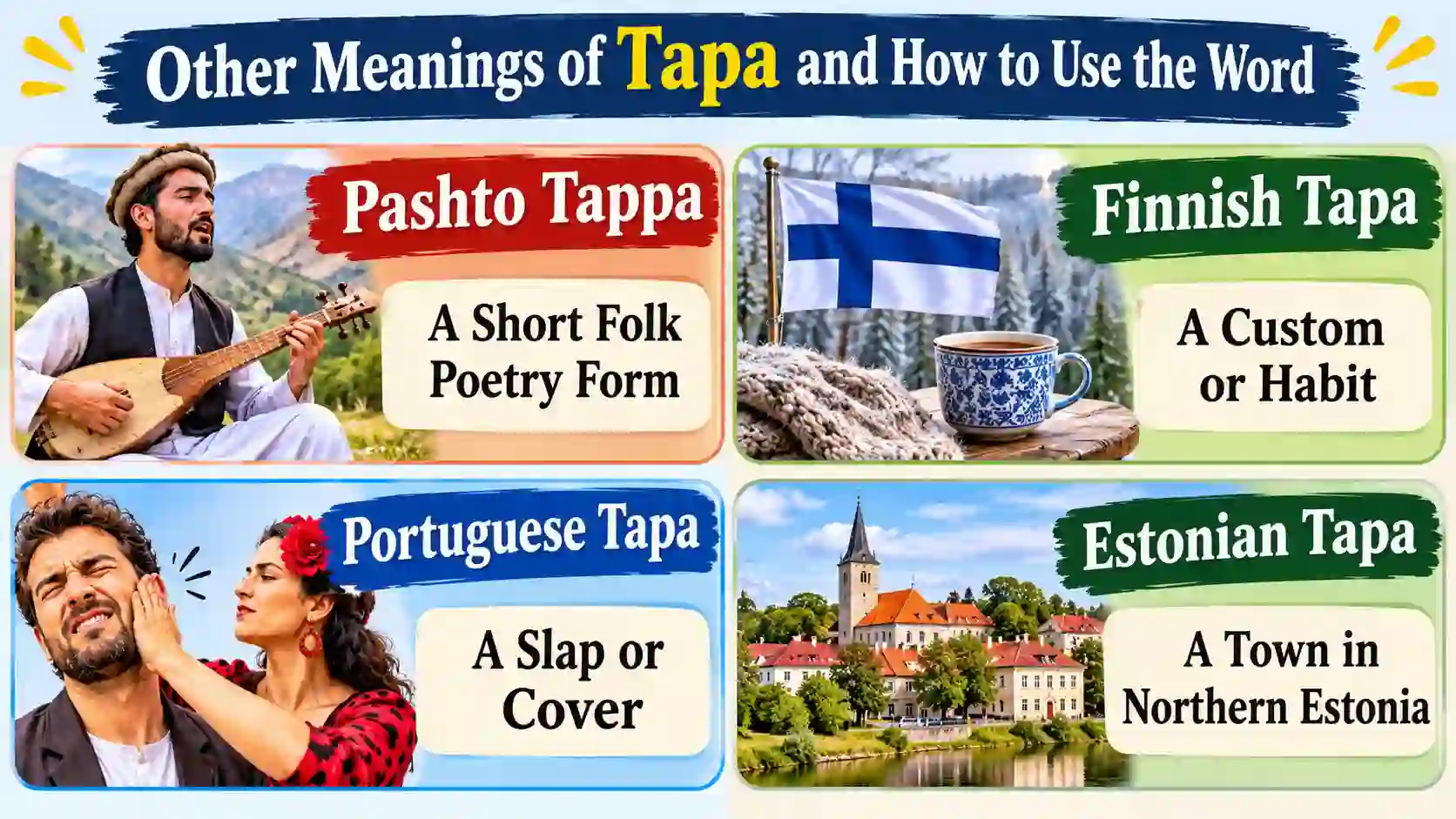
Beyond food and cloth, tapa appears in other languages and contexts.
Tappa in Pashto, Urdu and Punjabi Contexts
Tappa (ٹپہ / ټپه) is a short folk poetry form, especially popular in Pashto-speaking regions. It usually takes the shape of a brief couplet about love, longing or everyday life, and singers often perform it. In Punjabi music, Tappa also names a semi-classical vocal style. Meanwhile, the Sanskrit-derived word tapas means austerity or spiritual heat, which is a different meaning altogether.
Tapa in Other Languages and Places
- Finnish: tapa means a custom or habit.
- Portuguese: tapa can mean a slap or a cover.
- Estonian: tapa means “to kill,” and Tapa also names a railway town in northern Estonia.
How to Tell Which Meaning Applies
Check the context:
- Food: in a Spanish setting, it means a small dish; in a Filipino setting, cured meat.
- Fabric or art: it means Pacific bark cloth.
- Music or poetry: it means tappa, the folk form.
- Place or name: it may refer to Tapa, Estonia.
- Language: the language of the text usually settles the question.
FAQs
1. What does tapa mean in English?
It has no single English meaning. Depending on context, it usually refers to a small Spanish appetizer, a Filipino cured meat dish or Pacific bark cloth.
2. What does tapa mean in Spanish?
It means a lid or cover, and also a small portion of food that comes with a drink. The word comes from the verb tapar, “to cover.”
3. What is tapa in Filipino food?
Cooks marinate and cure thinly sliced beef (or sometimes pork or chicken) and then fry it. People usually serve it as tapsilog with garlic rice and egg.
4. What is tapa cloth made of?
Makers use the inner bark of trees, most commonly the paper mulberry. They soak and beat the bark into thin sheets and then decorate it.
5. What is the difference between tapa and tapas?
Tapa is singular, while tapas is plural. In English, “tapas” also describes the cuisine or restaurants that serve small shared plates.
6. How do you pronounce tapa?
Spanish speakers say TAH-pah, while Filipinos often say tah-PAH. English speakers usually say TAH-pah for tapa cloth.
7. What does tapa mean in Urdu or Hindi?
Tapa is not a standard Urdu or Hindi word. However, the closest match is tappa, a short folk poetry form, especially in Pashto.
8. Where did the word tapa come from?
Spanish tapa comes from tapar (“to cover”). In contrast, the Polynesian word is unrelated, and experts still debate the origin of the Filipino word.
Conclusion
The tapa meaning changes with the language, the culture and the setting. In Spanish, it means a lid or a small dish that comes with a drink. Meanwhile, in the Philippines, it means flavorful cured meat, best known in tapsilog. Across Polynesia, it means a handmade bark cloth with deep ceremonial value. It also appears in folk poetry, place names and other languages.
Overall, the easiest way to find the right meaning is to check the context. Ask whether the word is about food, fabric, music or a place, and notice which language the writer uses.

Hi, I’m Lucy, a content writer at ContentWireMedia. I enjoy exploring the meanings of words, common phrases, and everyday expressions. Through my writing, I aim to make language easy to understand by providing simple explanations, practical examples, and helpful insights that make learning enjoyable and help readers discover something new every day.